


A forex card is meant to remove the conversion layer that credit cards add. Load USD, spend USD, no rate surprises. But spend USD in Thailand, and a fee called the cross currency fee kicks in, because the card is now converting between two foreign currencies. The same logic applies on every multi-currency forex card whenever the spending currency does not match the wallet being drawn from.
A cross currency fee on a forex card is charged when the transaction settles in a currency different from the wallet being debited. Indian forex cards typically charge 2.5% to 3.5% on such transactions. Loading the correct wallet for each destination eliminates the fee entirely.
This guide explains when the cross currency fee kicks in on a forex card, how it differs from cross currency markup on credit cards, and the practical steps to avoid it on every leg of a multi-country trip.
How the Cross Currency Fee Works on a Forex Card
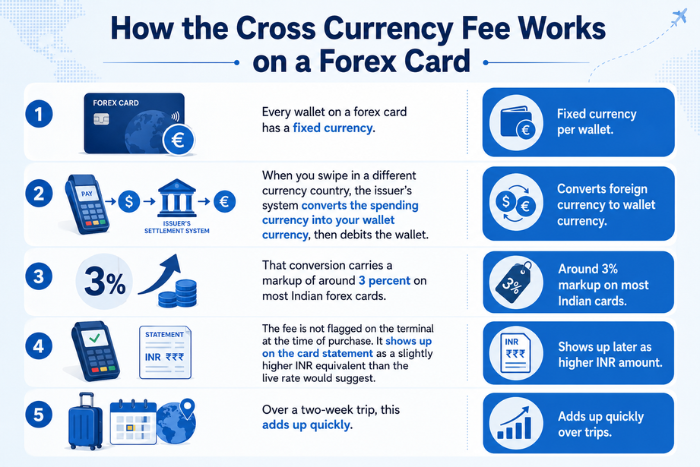
Every wallet on a forex card has a fixed currency. When you swipe the card in a country that uses a different currency, the issuer’s settlement system converts the spending currency into your wallet currency, then debits the wallet. That conversion carries a markup of around 3 percent on most Indian forex cards.
The fee is not flagged on the terminal at the time of purchase. It shows up on the card statement as a slightly higher INR equivalent than the live rate would suggest. Over a two-week trip, this adds up quickly.
Cross Currency Fee vs Cross Currency Markup
The two terms are often used interchangeably, but the mechanics differ slightly. Cross currency markup is the general term used for credit and debit cards converting between any two currencies. Cross currency fee is the specific name issuers use on forex cards when the card has to bridge between a loaded wallet and a different spending currency.
The end result feels the same: a 3 percent invisible cut on every transaction. The fix, however, is much easier on a forex card.
When the Cross Currency Fee Kicks In
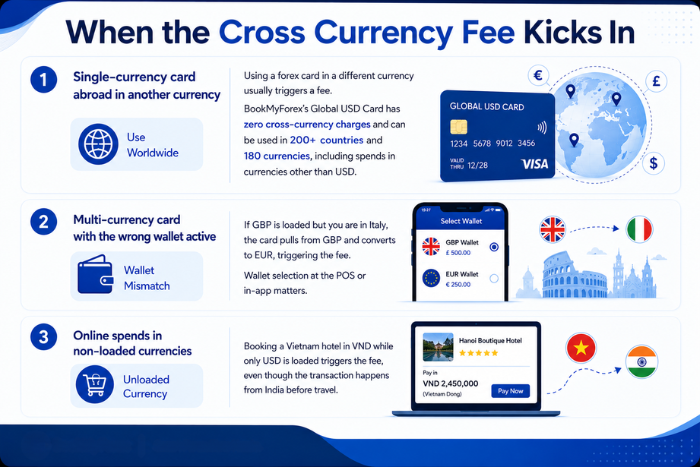
1. Single-currency card abroad in another currency
Many cards used in countries where the currency is different from the one loaded on your forex card trigger a fee on every transaction.
However, BookMyForex’s Global USD Card is a single currency card which comes with zero cross-currency charges, making it effortless to use in over 200 countries and 180 currencies.
While the card is a US Dollar card, you can convert it to other currencies and make transactions without incurring any cross-currency fees.
2. Multi-currency card with the wrong wallet active
If GBP is loaded but you are in Italy, the card pulls from GBP and converts to EUR, triggering the fee. Wallet selection at the POS or in-app matters.
3. Online spends in non-loaded currencies
Booking a Vietnam hotel in VND while only USD is loaded triggers the fee, even though the transaction happens from India before travel.
A Working Example of the Cross Currency Fee in Action
A traveller loads USD 2,000 on a single-currency forex card and spends the full amount across a 10-day Europe trip. The card auto-converts every EUR transaction at the issuer’s published rate, which sits around 3 percent above the interbank EUR-USD rate at the time of each swipe.
Spending the full USD 2,000 in Europe triggers approximately USD 60 in cross currency fees. The same USD 2,000 spent at home in the US would attract zero such fee, because the card is being used in its native currency. The fee is a function of currency mismatch, not transaction size or location alone.
What to Do If You Have Already Paid the Fee
Past transactions cannot be reversed. The fee is built into the conversion rate, not added as a separate line, so there is no chargeback process for it. The only practical action is forward-looking: identify which wallet should have been used, reload the right wallet for any remaining trip days, and adjust the spending pattern.
Some issuers offer a one-time in-app currency swap, where balance in the wrong wallet can be moved to the right one at the live rate. Check the app or call customer service before assuming the balance is stuck in the wrong currency.
Comparing Forex Card Providers on Fees
Cross currency fee structure varies between issuers. Most Indian forex cards charge between 2.5 and 3.5 percent on cross currency transactions, with no waiver tier. A few providers advertise zero markup on the wallet currencies they support, which effectively eliminates the fee when the right wallet is loaded for the destination.
Before buying a card, check three numbers on the provider’s published fee schedule: the cross currency fee percentage, the ATM withdrawal fee in foreign currency, and any annual or reload charges. These three combined determine the true cost of running the card across a trip, regardless of marketing claims.
How to Avoid the Cross Currency Fee
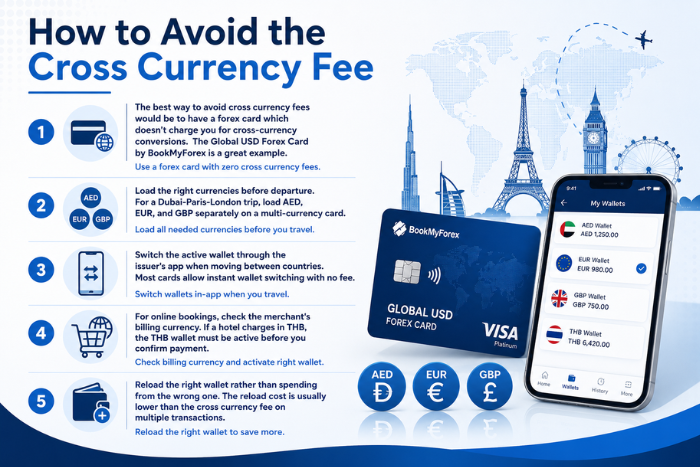
1. The best way to avoid cross currency fees would be to have a forex card which doesn’t charge you for cross-currency conversions. The Global USD Forex Card by BookMyForex is a great example.
2. Load the right currencies before departure. For a Dubai-Paris-London trip, load AED, EUR, and GBP separately on a multi-currency card.
3. Switch the active wallet through the issuer’s app when moving between countries. Most cards allow instant wallet switching with no fee.
4. For online bookings, check the merchant’s billing currency. If a hotel charges in THB, the THB wallet must be active before you confirm payment.
5. Reload the right wallet rather than spending from the wrong one. The reload cost is usually lower than the cross currency fee on multiple transactions.
Where to Check the Real Cost
The fee structure on forex cards is usually very obscure. However, the BookMyForex Forex Card charges page transparently lists ZERO cross currency, issuance, reload, and ATM withdrawal fees for our single currency card.
Compare the published fees against any card you currently hold or are considering. It is the fastest way to spot which provider quietly charges what.
The cross currency fee is one of the few travel costs that is fully avoidable with a single planning decision before takeoff. Match the wallet to the country, and the fee disappears from every line on the statement.
About the Author

Kshitij Pandey is the Content Manager at BookMyForex with over 7 years of experience in content marketing, blogging, and social media strategy. He has worked extensively on building engaging campaigns and informative resources that help users understand forex, international money transfers, and travel-related financial services.


