


Sending money to a child studying abroad, buying a US stock, paying for a foreign holiday on a forex card, or wiring tuition to a German university are all LRS transactions. Most Indian residents do not interact with the policy text directly; their bank handles it. But the limit, the documentation, the TCS, and the purpose codes that govern such transactions are all set by the Liberalised Remittance Scheme.
Liberalised Remittance Scheme or LRS is the RBI policy that lets every resident Indian, including minors, remit up to USD 250,000 per financial year for permitted current and capital account purposes. Each transaction routes through an authorised dealer with an A2 form declaration. The scheme was introduced in 2004.
This guide breaks down what LRS covers, what falls outside it, the current TCS regime after April 2026, and how Indian travellers and investors use the scheme without overshooting limits or triggering compliance issues.
What LRS Is and Why It Exists
The Liberalised Remittance Scheme was introduced by the Reserve Bank of India in February 2004 with an initial limit of USD 25,000 per year. The aim was to give resident individuals a simple, automatic route to remit money abroad without seeking RBI approval for each transaction. The limit has been raised in stages over twenty years to the current USD 250,000 per financial year.
The scheme covers both current and capital account transactions, which means it includes everyday expenses like travel and education alongside investments like buying foreign stocks or property.
Who Can Use LRS
Every resident individual under the Foreign Exchange Management Act (FEMA), including minors with a guardian-signed Form A2, can remit under LRS. The scheme is not available to corporates, partnerships, HUFs, or trusts; these entities operate under separate FEMA routes. NRIs and foreign nationals resident in India follow different rules.
What LRS Covers and Doesn’t
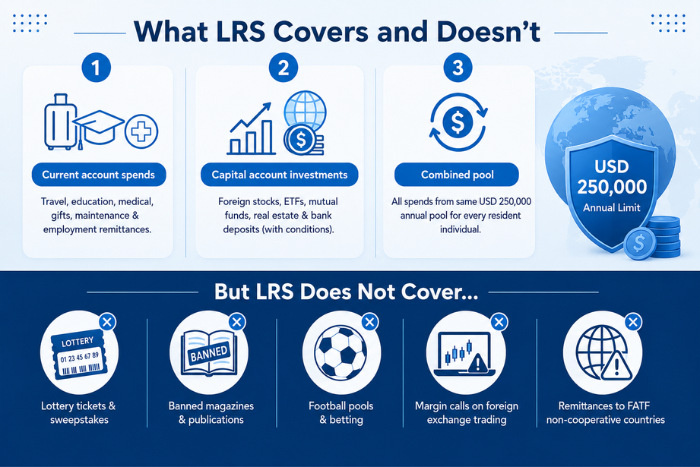
1. Current account spends
Foreign travel, education abroad, medical treatment, gifts to relatives outside India, maintenance of close relatives abroad, and employment-related remittances all fall under the current account portion of LRS.
2. Capital account investments
Buying foreign stocks, ETFs, mutual funds, real estate abroad, and depositing in foreign bank accounts (with conditions) all fall under capital account LRS.
3. Combined pool
All of these spends draw from the same USD 250,000 annual pool. Every resident individual (including a non-earning spouse or minor) gets the full USD 250,000 quota.
But LRS Does Not Cover…
Some categories are prohibited under FEMA and cannot be funded via LRS. These include remittances for lottery tickets, banned magazines, football pools, sweepstakes, and margin calls on foreign exchange trading. Remittances to countries identified by the Financial Action Task Force (FATF) as non-cooperative are also blocked.
Documentation: Form A2 and Purpose Codes
Every LRS transaction routes through an authorised dealer with a Form A2 declaration. The form captures the purpose code (e.g., S0306 for travel, S0305 for education), the beneficiary details, the source of funds, and a confirmation that the remitter has not breached the annual cap. PAN is mandatory.
The authorised dealer is responsible for reporting the transaction to the RBI through the daily LRS reporting system.
TCS on LRS Remittances (FY 2026-27)
The TCS on Foreign Exchange was updated by the Finance Act 2026 read with the Income Tax Act 2025, effective April 1, 2026. Remittances up to Rs 10 lakh per financial year continue to attract zero TCS regardless of purpose, except overseas tour packages (taxed from the first rupee).
Above Rs 10 lakh, the rate depends on the purpose: 2 percent for education (without loan), medical treatment; 20 percent for all other LRS purposes including general travel, foreign stock investments and property purchases; and a flat 2 percent with no threshold for overseas tour packages. Education remittances funded through a loan from a notified financial institution are fully exempt at 0 percent.
TCS is not an additional tax. It is adjustable against your annual income tax liability when filing returns.
Common LRS Use Cases and How They Work
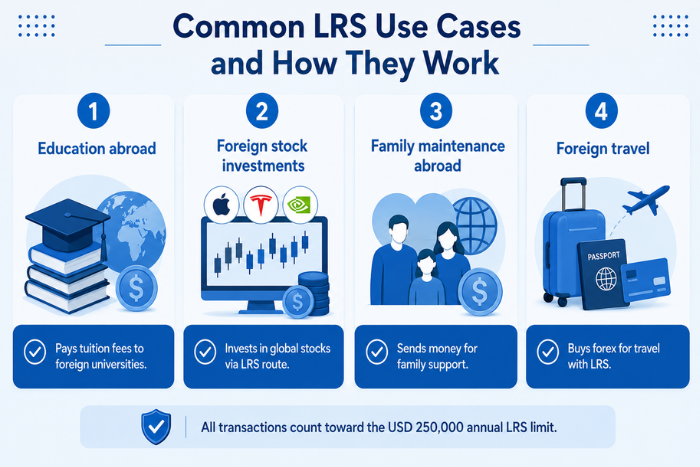
1. Education abroad
A parent sending USD 30,000 to a US university for tuition uses LRS with the S0305 purpose code. The transfer routes through an authorised dealer bank, the A2 form is signed at the time of booking, and the bank deducts 2 percent TCS on the amount above Rs 10 lakh. If the parent has taken a notified education loan, TCS is zero.
2. Foreign stock investments
An investor buying Apple, Tesla, or Nvidia shares through an Indian broker that partners with a US broker-dealer remits funds under LRS with the S0001 purpose code. Above Rs 10 lakh in a year, 20 percent TCS applies on the excess. The TCS is adjustable against income tax liability.
3. Family maintenance abroad
Money sent to a spouse, parent, or child residing outside India uses the S1301 purpose code under maintenance of close relatives. The recipient must be a close relative as defined under FEMA, and the purpose must be genuine maintenance, not investment.
4. Foreign travel
Loading a forex card or buying foreign currency cash for an upcoming trip falls under the S0306 purpose code. The full forex purchase counts toward the annual LRS pool, regardless of how much of it actually gets spent during the trip.
Annual Limit Reset and Tracking
The USD 250,000 cap refreshes every April 1 with the new financial year. Unused balance does not carry forward. Every authorised dealer in India reports LRS transactions to a central system, so the cap is enforced across providers, not per bank or per provider.
Forex card loads, wire transfers, and foreign currency demand drafts all count toward the same annual pool.
LRS-Compliant Remittances Without Unnecessary Paperwork
The cleanest way to use LRS for an outward remittance is through a regulated provider that handles documentation at the source. The BookMyForex international money transfer service processes remittances under full RBI compliance, with Form A2, purpose codes, and TCS reporting captured in the booking flow itself.
Transfers route through authorised dealer bank partners, with live interbank rates locked at the time of booking and no hidden spread layered on top. Settlement to common destinations including the US, UK, Canada, Europe, UAE, and Singapore typically completes within 12 to 48 working hours after KYC clearance.
LRS is the framework that lets Indians spend, study, and invest globally. Knowing how it works keeps the paperwork in the background and the planning in your hands.
About the Author

Kshitij Pandey is the Content Manager at BookMyForex with over 7 years of experience in content marketing, blogging, and social media strategy. He has worked extensively on building engaging campaigns and informative resources that help users understand forex, international money transfers, and travel-related financial services.


