


Wimbledon is the oldest tennis tournament in the world and the only Grand Slam still played on grass. As of July 2026 the fortnight is underway at the All England Club in London, and Indian fans are already planning next year in person. The trip is priced in pounds, and getting the money side wrong means the airport counter or your credit card quietly eats the budget before the first serve.
Wimbledon runs 29 June to 12 July 2026 at London’s All England Club. Indian visitors need a UK Standard Visitor visa (£135, roughly ₹17,100+), should budget ₹2 to 4 lakh for a week, and carry GBP on a zero-markup forex card instead of a credit card charging 3.5% forex markup plus GST.
This guide covers when Wimbledon is held, how to get tickets, what a trip costs, and the smartest way for Indian travellers to carry pounds.
When and Where Wimbledon Is Held
The 2026 Championships run across 14 days, from Monday 29 June to Sunday 12 July, at the All England Lawn Tennis and Croquet Club in the Wimbledon suburb of southwest London.
The Ladies’ singles final is on Saturday 11 July and the Gentlemen’s final on Sunday 12 July, and those finals-weekend seats are the hardest tickets to secure.
The venue sits about 40 minutes from central London by Tube and rail. Southfields station on the District line is the closest access point, with a signposted walk to the grounds.
Planning travel around this fixed window matters, because London hotel prices spike during the fortnight and drop sharply once the tournament ends.

How Indian Travellers Get Tickets
There is no single ticket window, and the options differ wildly in price and certainty.
The Ballot
The public ballot is a lottery run months in advance. Entry is free, but you cannot choose the day or court, and demand vastly outstrips supply. For an overseas visitor planning firm travel dates, the ballot is a gamble rather than a plan.
Queue and Resale
Wimbledon still sells a limited number of grounds and show-court tickets on the day to people who physically queue. A same-day resale desk also releases returned show-court seats at a low price. Both reward early arrival more than a big budget.
Official Hospitality and Debentures
Guaranteed premium seats are available through official hospitality packages and debenture resales, but these run into lakhs per person. This is the reliable route for travellers who want certainty and are willing to pay for it.
What a Wimbledon Trip Costs from India
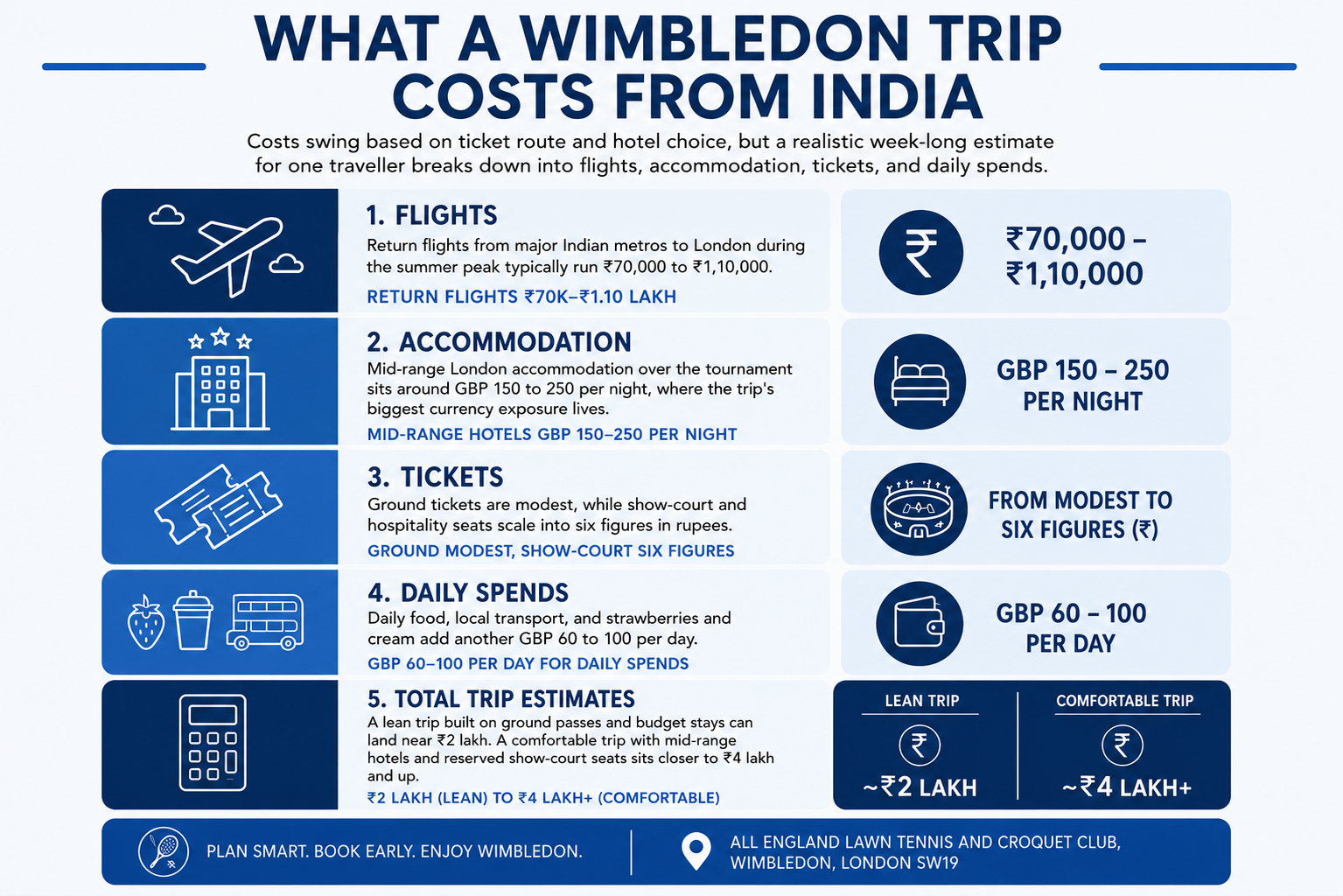
Costs swing based on ticket route and hotel choice, but a realistic week-long estimate for one traveller breaks down into flights, accommodation, tickets, and daily spends.
Return flights from major Indian metros to London during the summer peak typically run ₹70,000 to ₹1,10,000. Mid-range London accommodation over the tournament sits around GBP 150 to 250 per night, which is where the trip’s biggest currency exposure lives.
Ground tickets are modest, while show-court and hospitality seats scale into six figures in rupees. Daily food, local transport, and strawberries and cream add another GBP 60 to 100 per day.
A lean trip built on ground passes and budget stays can land near ₹2 lakh. A comfortable trip with mid-range hotels and reserved show-court seats sits closer to ₹4 lakh and up.
Visa Requirements for Indian Visitors
Indian passport holders need a UK Standard Visitor visa to attend Wimbledon. Indians are not eligible for the UK ETA, so a full visa is the only route. Following the April 2026 fee revision, the six-month visa costs £135, which is roughly ₹17,100+, plus a VFS Global service charge.
The application is online, biometrics are given at a VFS centre, and standard processing takes about three weeks, so applying six to eight weeks before travel is sensible.
Since 25 February 2026 the UK issues a digital eVisa rather than a passport sticker, accessed through a UKVI online account. The application asks for proof of funds, and a clean, documented forex load through a regulated dealer strengthens that funds trail rather than complicating it.
The Currency Question: How to Carry Pounds
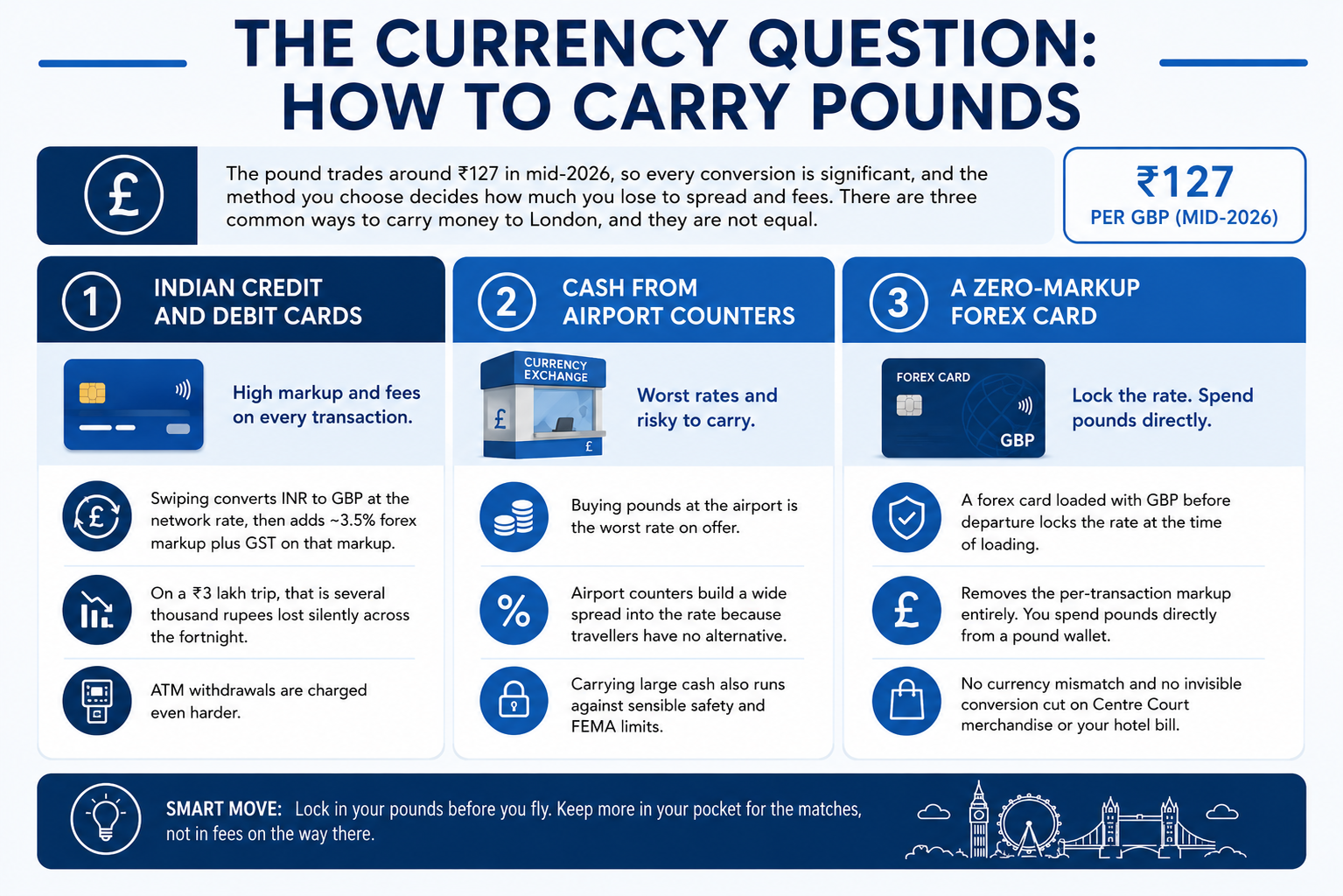
The pound trades around ₹127 in mid-2026, so every conversion is significant, and the method you choose decides how much you lose to spread and fees. There are three common ways to carry money to London, and they are not equal.
1. Indian Credit and Debit Cards
Swiping an Indian credit card in London converts INR to GBP at the network rate, then adds a forex markup of around 3.5 percent plus GST on that markup. On a ₹3 lakh trip, that is several thousand rupees lost silently across the fortnight, with ATM withdrawals charged even harder.
2. Cash from Airport Counters
Buying pounds at the airport is the worst rate on offer. Airport counters build a wide spread into the rate precisely because travellers arrive with no alternative. Carrying large cash also runs against sensible safety and FEMA limits.
3. A Zero-Markup Forex Card
A forex card loaded with GBP before departure locks the rate at the time of loading and removes the per-transaction markup entirely. You spend pounds directly from a pound wallet, so there is no currency mismatch and no invisible conversion cut on Centre Court merchandise or your hotel bill.
FEMA Rules Every Traveller Should Know
Foreign travel falls under the Liberalised Remittance Scheme, which lets a resident Indian spend up to USD 250,000 per financial year abroad, far above any Wimbledon budget. Within that, a few carry rules matter at the airport.
You can carry foreign currency notes up to USD 3,000 or equivalent per visit, with the rest carried on a forex card or in traveller’s cheques. Foreign exchange above USD 10,000 in total must be declared at Indian customs.
Loading a forex card is itself a documented, FEMA-compliant transaction, which keeps the whole trip clean on paper without any airport scramble.
How to Avoid Losing Money on the Trip
1. Load GBP into a forex card before departure so the rate is locked and the markup disappears. The BookMyForex Multicurrency Forex Card is built for exactly this.
2. Book flights and London hotels early, since prices climb steeply as the tournament fortnight approaches and drop once it ends.
3. Compare the live interbank rate against whatever your card or counter offers before converting, so the spread is visible rather than hidden.
4. Withdraw cash sparingly and only from the pound wallet, keeping cash on hand within FEMA limits and safety sense.
5. Keep the forex load documented through a regulated dealer, which doubles as clean proof of funds for the visa application.
Where to Check the Real Rates
Airport and card rates are rarely shown against the live interbank benchmark, which is where the loss hides. The BookMyForex live rate page shows the interbank GBP-INR rate in real time and lets you load pounds at that rate with zero issuance, reload, or cross-currency fees.
Compare that against the pound rate your credit card or airport counter quietly applies. It is the fastest way to see how much a Wimbledon trip actually costs once conversion is stripped out.
Wimbledon is a bucket-list trip for any tennis fan, and the tennis is the expensive part you cannot control. The currency is the part you can. Lock the pound rate before you fly, carry it on a zero-markup card, and the only surprise left is whether your favourite makes the final.
About the Author

Kshitij Pandey is the Content Manager at BookMyForex with over 7 years of experience in content marketing, blogging, and social media strategy. He has worked extensively on building engaging campaigns and informative resources that help users understand forex, international money transfers, and travel-related financial services.


