


The 2026 FIFA World Cup will be jointly hosted by Canada, the United States, and Mexico, marking the first time World Cup matches will be played on Canadian soil. With direct flights from Delhi to Toronto taking around 15 hours and strong Indian diaspora communities across the country, Canada offers Indian football fans a practical and less expensive alternative to crowded US host cities.
Canada will host 13 FIFA World Cup 2026 matches across Toronto and Vancouver, including Canadian national team group stage games, one Round of 32 fixture, and one Round of 16 knockout match at BC Place. Toronto hosts six matches, while Vancouver hosts seven, including knockout fixtures.
But planning a trip to Canada from India involves its own set of logistics: a Temporary Resident Visa with processing times that can stretch past three months, accommodation prices that have already started climbing, and a forex strategy that can save or cost you lakhs depending on how you handle it. This guide covers all of it.
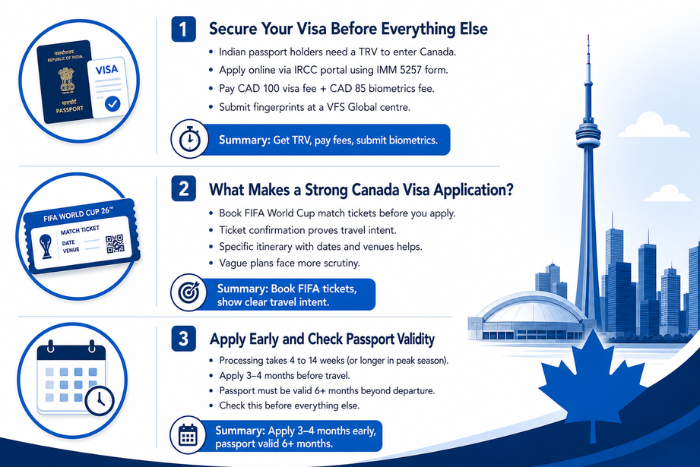
Secure Your Visa Before Everything Else
Indian passport holders need a Temporary Resident Visa (TRV) to enter Canada. The application is submitted online through the IRCC (Immigration, Refugees and Citizenship Canada) portal and involves completing the IMM 5257 form, paying the CAD 100 visa fee plus a CAD 85 biometrics fee, and submitting fingerprints at a VFS Global centre in Delhi, Mumbai, Chennai, Kolkata, Bangalore, Hyderabad, or Chandigarh.
What Makes a Strong Canada Visa Application?
Book your FIFA World Cup match tickets before you apply. Ticket confirmation from the official FIFA platform serves as concrete evidence of travel intent and strengthens your application considerably. IRCC officers look for specificity in itineraries, and a vague tourism purpose invites more scrutiny than a documented event with dates and venues.
Processing times for Indian applicants currently run anywhere from 4 to 14 weeks depending on caseload, and peak season applications can take longer. Apply at least three to four months before your intended travel date. Your passport must be valid for at least six months beyond your planned departure from Canada. Check this before everything else.
Which Canadian Cities to Target?
Canada has only two host cities, but they are very different in character and offer distinct advantages depending on what kind of trip you are planning.
1. Toronto
Toronto hosts six matches at BMO Field, including Canada’s opening game on June 12 against Bosnia and Herzegovina. It is the easier city for Indian travellers to reach, with Air India and Air Canada operating direct flights from Delhi.
The Brampton and Scarborough neighbourhoods are home to one of the largest Indian diaspora communities in the world, which means access to familiar food, groceries, and cultural comfort throughout a long trip. For vegetarian travellers especially, this is a genuine practical advantage.
2. Vancouver
Vancouver hosts seven matches at BC Place, making it the busier of the two Canadian venues. Canada plays two decisive group stage matches here: against Qatar on June 18 and Switzerland on June 24. It is also the only Canadian city hosting matches beyond the group stage, with a Round of 32 and a Round of 16 on the schedule.
For fans building a multi-city itinerary, the Toronto-to-Vancouver domestic flight takes about 4.5 hours and is well-served by Air Canada and WestJet. Catching Canada’s full group stage run across both cities is entirely practical and makes for a natural two-stop trip.
Breaking Down the Total Trip Cost
A 10-to-12-day trip from India covering both Canadian host cities and two to three matches will realistically cost between Rs 4 lakh and Rs 7.5 lakh per person, depending on travel style and how far in advance bookings are made.
1. Flights Take the Largest Share of the Budget
Round-trip economy fares from Delhi to Toronto start at Rs 85,000 to Rs 1.3 lakh when booked early. Direct flights on Air India and Air Canada are available, though one-stop options via Gulf carriers or European hubs can bring costs down at the expense of travel time. Delhi to Vancouver has fewer direct options and fares tend to run slightly higher. Prices for June and July departures have already started climbing, so there is no advantage to waiting on this.
2. Stay Costs Rise Fast During the Tournament
In Toronto, standard 3-star hotels near downtown are running CAD 200-350 per night during match weeks, with properties near BMO Field already quoting over CAD 900 per night. Vancouver is more expensive: the city’s average hotel rate hit a record CAD 330 per night in July 2025, and tournament-week pricing is expected to push well beyond that. Budget alternatives exist. Staying in Mississauga instead of downtown Toronto, or in Burnaby or Surrey instead of central Vancouver, can cut nightly rates by 30-40% while keeping transit access to the stadiums intact.
3. Ticket Prices Add Up Quickly
Match tickets on the official FIFA platform range from USD 35 for lower-category group stage seats to several hundred dollars for knockout matches. Canada’s home games carry a clear premium. Group stage tickets for Canada fixtures at BC Place start at USD 370 for Category 3 seats and rise to USD 980 for Category 1. Budget at least USD 200-500 per person per match for a realistic seat at a knockout game.
4. Daily Expenses Add Up Faster Than Expected
Daily spend runs CAD 80-140 for budget travel and CAD 150-280 for mid-range comfort. Two things consistently catch Indian visitors off-guard: Canada charges GST (5% federal) plus provincial sales tax on top of displayed prices, totalling 13% combined HST in Ontario and 12% in British Columbia, and tipping at restaurants runs 15-20%, which is culturally expected and not optional. These additions can push a CAD 50 meal to CAD 65 in practice.

Forex Planning is the Part Most Fans Get Wrong
Handling CAD is where the trip either holds to budget or quietly bleeds money. Most Indian travellers assume their regular debit or credit card will work fine for international purchases. It does work, but every transaction gets converted at the day’s exchange rate, the card network adds its margin, and the bank charges a foreign transaction fee of 2-3.5% on top. On a CAD 4,000 trip, that markup alone costs Rs 7,000-12,000 extra, spread invisibly across dozens of transactions.
Why a Forex Card Makes More Sense
The right tool is a CAD forex card loaded before departure. The exchange rate is locked at the time of loading, and every CAD transaction abroad is debited directly from the stored balance with zero additional conversion markup. The card works identically to a local debit card at every POS terminal, ATM, and online merchant in the country.
The BookMyForex Multi-Currency Forex Card lets travellers lock in live interbank CAD rates, significantly better than the rates offered at airport counters or bank branches. The card supports loading in CAD directly, which means every transaction in Canada is settled at the rate you locked in, with zero forex markup. Travellers also benefit from free international ATM withdrawals with zero issuance, reload, unload, or annual charges, making it a cost-effective companion for extended tournament trips across both Canadian host cities.
How Much CAD Should You Carry?
For a 12-day trip covering Toronto and Vancouver, two to three matches, mid-range accommodation, and daily expenses, loading CAD 3,500-5,000 is a practical starting point. Begin conservatively since the app reload feature lets you top up instantly if your spend runs higher than planned.
For travel to Canada, it is generally recommended to carry most of your travel funds on a forex card while keeping a smaller amount in cash for convenience. A balanced split is around 80-90% on a forex card and 10-20% in CAD cash, as cards are widely accepted across Canada while cash remains useful for tips, transit fare top-ups, and small vendors near stadiums on match days.
About the Author

Kshitij Pandey is the Content Manager at BookMyForex with over 7 years of experience in content marketing, blogging, and social media strategy. He has worked extensively on building engaging campaigns and informative resources that help users understand forex, international money transfers, and travel-related financial services.


