


For Indians visiting Toronto, Vancouver, or Banff, the planning question is not just how much CAD to carry, but how to hold and spend it without losing money to invisible conversion fees on every transaction.
CAD is the only legal tender in Canada. USD is sometimes accepted near the border but at poor rates (merchant’s choice). The cleanest approach for Indian travellers is to load CAD on a forex card, carry a small CAD cash buffer, and avoid INR or USD payments inside Canada.
This guide covers why CAD is the right currency to spend in Canada, where USD might be accepted and why you should still decline it, how much CAD to carry, and the spending habits that keep your trip budget from leaking 3 to 5 percent invisibly.
CAD Is the Only Legal Tender
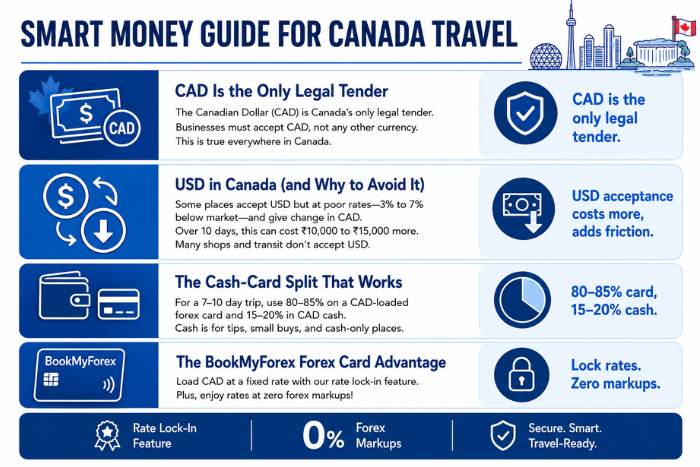
The Canadian Dollar (CAD), issued by the Bank of Canada, is the sole legal tender across all ten provinces and three territories. Every business is legally obligated to accept CAD; no business is legally obligated to accept any other currency. This is true even in Niagara Falls, Vancouver waterfront, or Toronto’s airport hotels, where USD acceptance feels common.
USD in Canada (and Why to Avoid It)
Some hotels, large retail chains, and tourist attractions near the US border accept USD as a courtesy. They convert at their own rate, usually 3 to 7 percent below the live interbank rate. Change is given in CAD at that same poor rate. Over a 10-day trip, paying in USD where CAD is expected can cost an extra Rs 10,000 to Rs 15,000.
There is also a practical issue: many smaller shops, cafes, and transit systems do not accept USD at all. Carrying USD as a backup currency inside Canada creates more friction than value.
The Cash-Card Split That Actually Works
For a 7 to 10 day Canada trip, the recommended split is approximately 80 to 85 percent on a CAD-loaded forex card and 15 to 20 percent in CAD cash. Cash covers taxi tips, small markets, and the rare cash-only vendor.
The BookMyForex multicurrency forex card is a smart bet for you. You can load CAD at a fixed rate by using our rate lock-in feature. What else? Those rates are at zero forex markups!
Where Indians Spend Most in Canada
1. Accommodation
Hotels in Toronto, Vancouver, and Banff bill in CAD. Some Vancouver hotels near the US border accept USD but at unfavourable rates. Pay in CAD directly.
2. Inter-city travel
Air Canada, VIA Rail, and Megabus all bill in CAD. Online bookings made from India in CAD via an Indian credit card trigger cross currency markup; book through a CAD wallet on a forex card if possible.
3. Food and groceries
Indian grocery stores in Brampton, Scarborough, and Surrey are cash-friendly and priced in CAD. Restaurants accept cards universally but expect 15 to 20 percent tipping, in CAD.
4. Tourist attractions
Niagara Falls, CN Tower, Capilano Suspension Bridge, and similar sites accept both currencies. Always pay in CAD.
Avoiding the DCC Trap at Canadian POS
Card terminals across Canada increasingly offer Dynamic Currency Conversion: a screen asking whether you want to pay in INR or CAD. Always choose CAD. Choosing INR lets the merchant set the conversion rate, typically 3 to 8 percent worse than what your card would have applied, plus markup.
This single click can save Rs 200 to Rs 500 on a Rs 5,000 transaction, repeated across every meal, cab, and hotel.
+Tipping and Tax Add-Ons to Plan For
Canada charges combined HST or GST plus PST ranging from 5 to 15 percent on top of listed prices, depending on the province. Restaurants and service staff expect 15 to 20 percent tipping.
A listed CAD 100 meal can reach CAD 130 to CAD 135 by the time you pay. Factor this into per-day budgets.
Banking and ATM Use in Canada
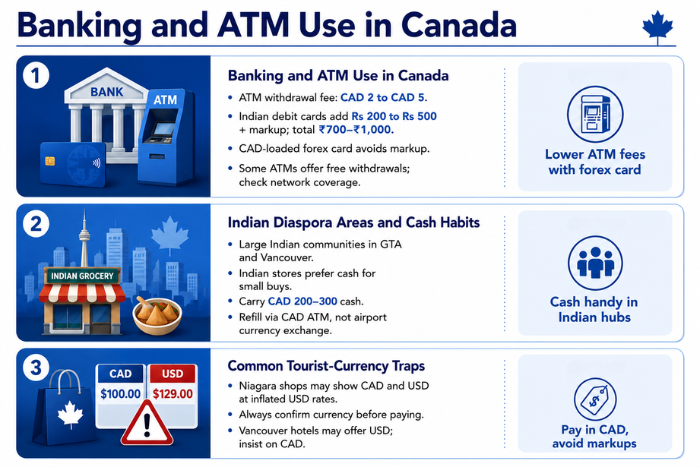
Major Canadian banks operate widely across cities. Withdrawing CAD from a Canadian bank ATM using a forex card costs roughly CAD 2 to CAD 5 per withdrawal at the ATM end.
An Indian debit card adds Rs 200 to Rs 500 issuer charges plus cross currency markup, often making each withdrawal cost ₹700-₹1,000.
Using a CAD-loaded forex card eliminates the issuer markup. Select ATMs offer free withdrawals to specific card networks; check the issuer’s network coverage before travel.
Indian Diaspora Areas and Cash Habits
Brampton, Mississauga, and Scarborough in the Greater Toronto Area carry one of the largest Indian-origin populations outside India. Surrey and parts of Vancouver carry significant Punjabi communities.
Indian grocery stores, restaurants, and small businesses in these areas often prefer cash for small transactions, though cards are accepted universally for larger spends.
Carrying CAD 200-300 in cash on day one is a sensible buffer for groceries, tipping, and small market purchases. Reload the cash buffer mid-trip using a CAD ATM withdrawal rather than converting INR at airport counters.
Common Tourist-Currency Traps to Watch For
Niagara Falls border-area shops sometimes display prices in both CAD and USD, with the USD price set at an inflated rate. Always confirm which currency the bill is being charged in before tapping the card. Some Vancouver hotels offer to charge in USD; politely insist on CAD.
Tracking the CAD-INR Rate
For travellers heading to Canada, the live CAD to INR rates on BookMyForex update through the trading day at interbank reference levels. The same page shows recent movement, which helps with timing a forex booking before a Canada trip or a remittance to a student studying there.
Airport counters and credit cards add 6 to 15 percent above the live interbank rate. Booking CAD at lowest rates with us eliminates that spread. A CAD-loaded forex card combined with declining DCC at every Canadian POS keeps the trip budget intact end-to-end.
Canada is one of the easiest destinations for Indian travellers to manage forex cleanly. Load CAD, decline DCC at every terminal, and the trip budget holds its shape through the last day.
About the Author

Kshitij Pandey is the Content Manager at BookMyForex with over 7 years of experience in content marketing, blogging, and social media strategy. He has worked extensively on building engaging campaigns and informative resources that help users understand forex, international money transfers, and travel-related financial services.


